


Documentary Film Council: A UK film industry co-operative first!
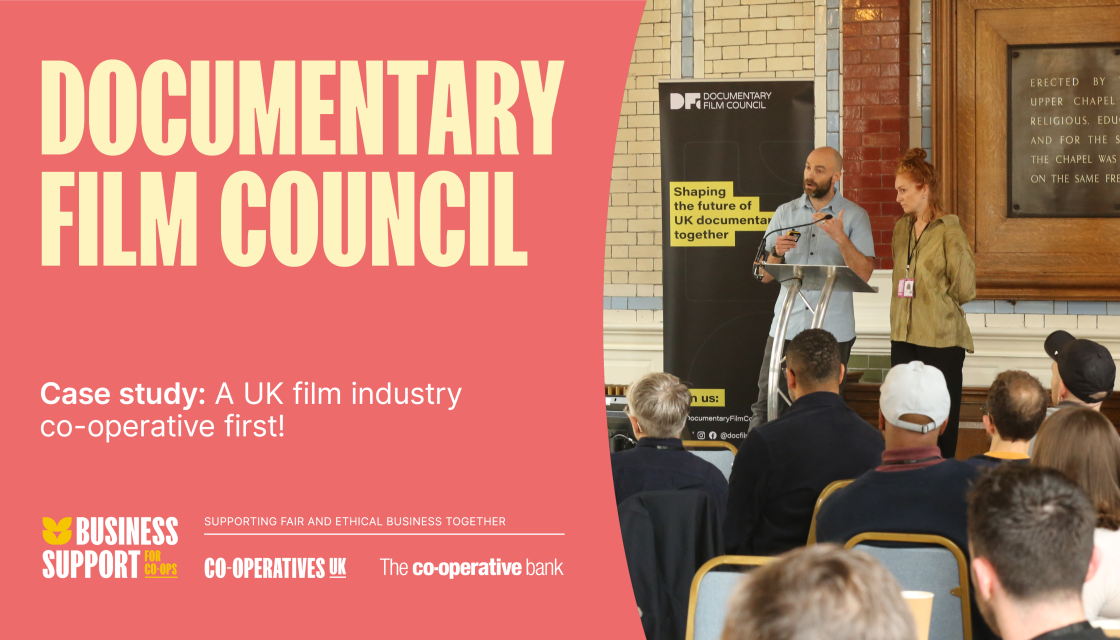
In the notoriously competitive film industry, a group of pioneering documentary makers decided to break the mould and create a national community‑run representative body to serve the interests of everyone in their sector…
In 2018, Dr Steve Presence, Senior Lecturer in Film and TV at Bristol University, began researching the UK’s documentary film industry and discovered that there was no national representative body for those working in this sector.
“We surveyed and interviewed hundreds of filmmakers and executives – and it became increasingly clear that this part of our film and TV industries had not been very well looked after by the government and other institutions.
“Partly, this is due to commercial pressures and the rise of streaming platforms, but it’s also a consequence of co‑ordinated attacks on our public service media infrastructure. As a result, the documentary sector is really struggling,” he said.
“Drawing attention to these challenges – and developing the policy frameworks we need to address them – is really difficult when you don’t have a national body with a remit to advocate in the interests of the sector.”
This resulted in the creation of the Documentary Film Council (DFC), the first national membership organisation for documentary in British film history. And because the DFC was set up as a charitable community benefit society, it’s also the first national trade body in the UK screen industries to incorporate as a co‑op.
With seed funding from the Arts and Humanities Research Council, stakeholders across the industry were consulted on potential governance structures for the new institution.
According to Steve, setting up as a community‑led organisation was crucial for everyone involved. “We knew it should be democratic and transparent and we ultimately chose the community benefit society (CBS) model because it’s about benefitting a wider community – this is by and for the documentary community. It’s not about self‑interest,” he said.

Emily Copley, the DFC’s joint Acting CEO, added “Another thing that worked for us about the co‑op model is the explicit commitment to co-operative values and principles – solidarity, democracy, independence and self-education.
“Those sorts of values are important to the documentary community. A lot of people who make documentaries are socially engaged and care passionately about equality, openness and caring for others. It’s a really good fit.”
Set up in June 2023, the DFC now has more than 800 members across the country. They’ve submitted evidence to parliament on the challenges facing the sector and are working with the British Film Institute and other government agencies to develop more effective policies for non‑fiction film in the UK.
The DFC has also helped fund the Documentality initiative to address mental health in the industry; raised the profile of the sector via the UK’s first ever national documentary directory; and has been working with groups around the country to set up local film clubs and develop the sector across the UK.
In 2024, the DFC held its first board election. As Emily explained, this was a major milestone: “For the first time ever, the UK has a democratically elected group of trustees to represent the documentary community. That’s not been possible until now because we’ve never had a national membership body in the UK.”
For support with setting up as a CBS, embedding its governance structures and conducting its first election, the DFC was awarded expert consultancy from Adrian Ashton via the Business Support for Co‑ops programme delivered by Co‑operatives UK in partnership with The Co‑operative Bank.
“He has been really good and flexible – and allowed for us working at quite a slow pace, which means we spread out the support over an extended period,” said Steve.
“We also had a lot of advice and guidance on running elections, as we’d not done that before. It was a big deal for us as a national body to run our first election smoothly. Thanks to Adrian’s help, it was hugely successful.
“We had 31 candidates stand for eight seats on the board, and a 64% turnout in the election, which was fantastic. Adrian worked with us on our timeframe and helped make sure everything was as transparent as possible – including recommending the excellent provider we commissioned to run the actual ballot.
“Adrian’s encouragement has been really valuable too. It’s great to be able to go to someone who knows and just ask – ‘are we doing this right?’ And even better when they say ‘Yes.’”
Emily adds, “His help has been crucial in supporting us to adopt the co-operative model. We’re still really excited about it – and obviously also still learning as we go along.
So far, it’s been overwhelmingly successful, with lots of member engagement. People all over the industry – not just in the UK but also in Europe and the US – are supporting us and are excited about us adopting this model and making it work.”
Start, grow or convert to a co-op with tailored business support

Business Support – start your co-op

Business Support – convert to a co-op
Business support – help for your co-op
The Co-operative Bank: Free everyday community banking*
Lancaster Music Co‑op: The fight to save a much-loved creative space

Felt Nowt: A comedy co-op creating work for stand-ups
Allie’s Art Club: Co-operative creativity generating positive change
